Words Klondike : Associations
Higgs StudioWord
4.7221.00 Reviews
- Version
- 1.15.2
- Installs
- 100.00K
- Age Rating
- Everyone
Screenshots
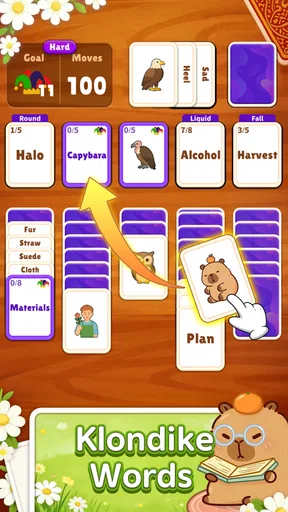
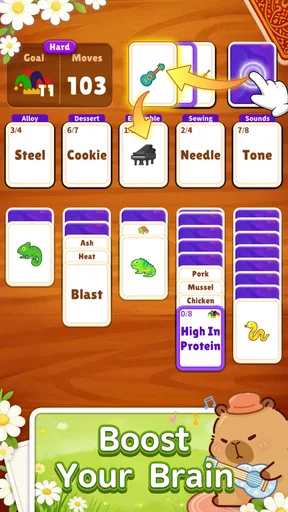
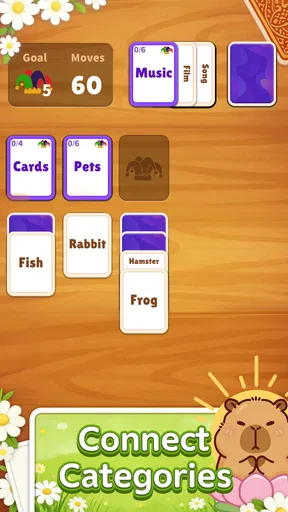
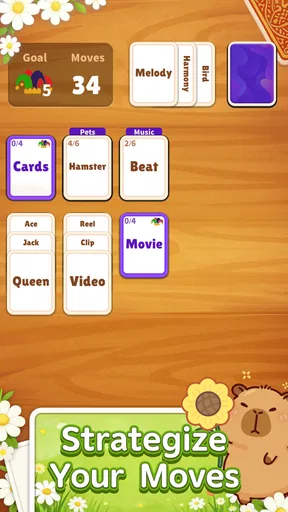
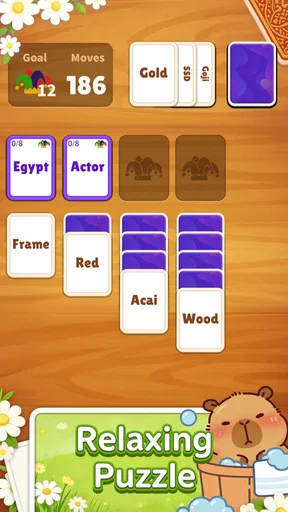
Our Review of Words Klondike : Associations
 Analysis by Appyee
I often reach for a word puzzle when I have a few spare minutes but don’t want to start a game that demands a long, uninterrupted session. Words Klondike: Associations suits that kind of break: it asks me to look for relationships between words, while its solitaire-style card sorting gives the task a more hands-on feel than a plain list of clues. The idea is easy to understand, though finding the intended connections can take more thought than the first glance suggests.
Where the puzzle can slow you down
The central challenge is not simply knowing what each word means. It is deciding which words belong together and spotting the connection the puzzle expects. A word may fit several possible themes in your mind, so moving too quickly can send you down a plausible but unhelpful path. I find it more satisfying when I pause to compare the whole group instead of treating each card as an isolated clue.
That makes the game a better fit for players who enjoy flexible thinking than for anyone who wants every answer to be obvious from a definition. If I get stuck, I try naming a possible category in plain language—such as objects used for the same task or words linked by a shared idea—then check whether it accounts for the full set. This small habit can reveal when I am stretching a connection just to make my first guess work.
It is also worth remembering that an unfamiliar word can slow down an association puzzle even when the grouping logic is sound. If a term seems to be the obstacle, I avoid burning through guesses based on a meaning I am not sure of. Taking a moment to think of common uses or alternate meanings is often more useful than immediately changing every card arrangement.
Getting comfortable with the card-sorting rhythm
The solitaire framing gives the word task a physical rhythm: I am not only solving a category puzzle, but also sorting cards into groups. That distinction matters when choosing what to play. Someone who likes the tidy, incremental feeling of arranging a layout may find the format more engaging than a conventional word-search grid. Someone who mainly wants to guess definitions or spell words may prefer a crossword or spelling game instead.
For a short session, I would treat each puzzle as a complete little exercise rather than racing through several. First scan all the cards, then look for a connection that explains multiple words, and only then commit to a group. This is a practical way to limit false starts, especially when several words seem related in different ways. It also makes the moment of recognizing a category feel earned rather than accidental.
If I am playing while waiting for a bus or sitting through a quiet break, I keep the session low-pressure: one puzzle, a brief pause if the pattern is not coming, and then another look with fresh eyes. The game’s appeal is in noticing relationships, so forcing an answer while distracted can make it feel more frustrating than it needs to be. A few seconds away from the screen may be a better move than repeatedly rearranging the same cards.
Setup checks and sensible expectations
Words Klondike: Associations is a free word game from Higgs Studio, and it is listed for Android devices running version 6.0 or later. The current version is 1.13.0. Before installing, I would check that the device meets that minimum and has enough room for another game; that simple check can prevent a failed or interrupted installation from being mistaken for a puzzle problem.
The game is rated for Everyone, but that does not mean every word or association will be equally familiar to every player. A younger player may enjoy the card grouping while occasionally needing help with vocabulary, and an adult who is fluent in English may still encounter a word used in an unfamiliar sense. I would play together or discuss a tricky clue rather than assume that the age rating means every round is effortless for children.
It has a 4.7 average from around 3.7 thousand ratings, with more than 100 thousand installs. Those figures suggest that many players have found an audience for this particular mix of words and solitaire-style sorting, but they cannot tell me whether its vocabulary or pace will suit an individual. The most useful test is whether you enjoy making connections when more than one answer initially seems possible.
There are in-app purchases, priced from $1.99 to $99.99 per item. I would approach those as optional spending rather than part of the basic decision to try the game: it is free to download, and a purchase is not automatically a solution to a difficult puzzle. If a payment prompt appears, take a moment to check what is being offered and whether you actually want it before confirming. That is sensible for any free-to-start game, particularly if a child is using the device.
Recovering when a round feels stuck
When I lose the thread of a puzzle, I find it helpful to reset my reasoning before assuming something is wrong with the game. I look at every word again, search for a category broad enough to include the whole group, and test whether a second meaning fits better than the most obvious one. The point is not to force a clever interpretation; it is to see whether the relationship remains convincing across all the cards.
If the app itself seems unresponsive, I separate that problem from the puzzle. I check that the game has finished loading, close and reopen it if the screen appears frozen, and make sure the device is not struggling with several other active apps. If an installation or update does not complete, I check the internet connection and available device storage before trying again. These are general device checks, not special tricks for solving a level.
Hints can be useful when I have genuinely exhausted my ideas, but I would save them for a point where they can teach me something. Before using one, I try to identify what I have ruled out and which words remain uncertain. That way, the nudge is more informative: I can compare it with my reasoning instead of tapping through without learning what made the association work.
How it compares with other word games
Compared with crosswords, this game puts less emphasis on filling a fixed grid from direct clues and more on recognizing relationships among words. Compared with word searches, it asks for interpretation rather than simply scanning for a visible spelling. And beside a standard solitaire game, the vocabulary task changes the feel of each move: success depends on both sorting and seeing a meaningful category.
That combination is its clearest point of difference, but it also defines who may not enjoy it. If you want a purely relaxing card game with familiar rules, the word associations can interrupt that flow. If you want a language workout with precise definitions or spelling practice, a dedicated vocabulary or crossword app may serve you better. I would choose this one when the enjoyable part is connecting ideas, not when I want a single correct clue for every move.
It can also work as a shared, casual activity. Two people can look at the same words and explain why they would group them, turning a quiet puzzle into a short conversation. The useful twist is to compare the reasoning rather than just race to the answer: one player may notice a connection the other overlooked, while a disagreement can expose how differently a word is understood. That makes it suitable for a relaxed break, though it is less ideal if everyone wants a fast competitive match.
Who will enjoy it—and who may prefer something else
I would recommend it to people who like word puzzles but want a format that does not feel exactly like a crossword, and to casual players who enjoy solving one small challenge at a time. It is also a reasonable choice for someone who likes discussing word meanings with a friend or family member. The combination of card sorting and association gives those players more to think about than simply spotting a hidden word.
I would skip it if you dislike ambiguous clues, get irritated when a word can belong to several categories, or expect every round to teach vocabulary in a structured way. It is not the option I would pick for spelling drills, long narrative play, or a traditional solitaire session without language decisions. Nor would I recommend buying anything just because a puzzle is difficult; a pause or a fresh look may be all that is needed.
First Impressions
The first thing that caught my eye was the app’s sleek design. You know how some apps just feel cluttered the moment you open them? Not this one. Words Klondike: Associations has a clean and inviting interface, making it super user-friendly. The colors are easy on the eyes, and the navigation is straightforward. You won’t find yourself lost in endless menus trying to figure out where to start.
Gameplay and Mechanics
So, what’s the deal with the gameplay? Well, it’s all about associations. You’re given a jumble of words, and your task is to connect them in a meaningful way. At first, it might seem simple, but as you progress, the challenges get tougher. It’s like solving a puzzle where you need to find the perfect fit for each piece.
The game is divided into different levels, each with its unique set of words. I found myself getting hooked on completing each level and was genuinely excited to see what the next one had in store. The difficulty ramps up gradually, which is great because it keeps you engaged without overwhelming you.
Features I Loved
One thing I absolutely loved about Words Klondike: Associations is its hint system. If you’re ever stuck, you can use hints to nudge you in the right direction. It’s a lifesaver for those tricky words that just won’t click.
Another cool feature is the daily challenges. These are a great way to keep the game fresh and exciting. Even if you’ve completed all the levels, the daily puzzles give you a reason to come back every day. Plus, they’re a fantastic way to earn extra hints!
Why It’s Worth a Download
If you’re someone who loves word games and puzzles, this app is definitely worth your time. It’s challenging enough to keep you engaged but not so difficult that you’ll want to throw your phone out the window. Plus, it’s a great way to improve your vocabulary and keep your mind sharp.
What’s even better is that the app is free to download. There are in-app purchases, but they’re not necessary to enjoy the game. You can easily progress through the levels without spending a dime, which is a huge plus in my book.
A Few Things to Keep in Mind
While I enjoyed the app thoroughly, there are a couple of things you might want to keep in mind. The ads can be a bit annoying at times, especially if you’re on a roll with the puzzles. However, they’re not overly intrusive and can be removed with a small purchase.
Also, some of the words might be unfamiliar, which can make the game a bit challenging for younger players. But hey, that’s part of the fun, right? Learning new words and expanding your vocabulary is always a win!
Final Thoughts
All in all, Words Klondike: Associations is a delightful blend of fun and challenge. It’s a perfect game for those moments when you need a mental break but still want to keep your brain active. Whether you’re a word game enthusiast or just looking for something new to try, this app is definitely worth a shot. So go ahead, give it a download, and let your word association skills shine!
Verdict
Strengths of Words Klondike : Associations
- Engaging word puzzles keep the mind sharp.
- Simple and intuitive user interface.
- Regular updates introduce new challenges.
- Offline mode available for on-the-go play.
- Minimal ads enhance uninterrupted gameplay.
Limitations of Words Klondike : Associations
- Limited hints can lead to frustration.
- Repetitive puzzles may bore advanced users.
- In-app purchases can be pricey.
- No multiplayer or social features.
- Occasional bugs affect performance.
Other Releases by Higgs Studio
View All
Tile Master® - Matching Game
Board3.6
Similar Picks in This Category
View All
Word Search - Word Puzzle Game
Bluetile4.8

Word Search Quest - Puzzles
Blackout Lab4.8

CodyCross: Crossword Puzzles
Fanatee, Inc.4.7

Words of Wonders: Crossword
Fugo Games4.9

Wordscapes: Word puzzle game
PeopleFun4.7

Word Search Explorer
PlaySimple Games4.9
Frequently Asked Questions
What is Words Klondike: Associations?
Words Klondike: Associations is a word puzzle game that challenges players to connect words based on associations. It's designed to enhance vocabulary and cognitive skills through engaging gameplay. Players must think creatively to solve each level, making it both entertaining and educational.
How do I play Words Klondike: Associations?
In Words Klondike: Associations, players are presented with a grid of letters and must form words by linking them together based on thematic associations. The objective is to find all the words related to the given theme. Players can swipe letters in any direction to create words, making strategy key to progressing.
Is Words Klondike: Associations free to play?
Yes, Words Klondike: Associations is free to download and play. However, it offers in-app purchases for items like hints or premium features that can enhance the gaming experience. Players can enjoy the core game without spending money, but purchases can help overcome challenging levels.
What are the minimum device requirements for Words Klondike: Associations?
Words Klondike: Associations requires Android 5.0 or iOS 10.0 and above to run smoothly. The game is optimized for both smartphones and tablets, ensuring a seamless experience across devices. Adequate storage and a stable internet connection are recommended for downloading updates and accessing online features.
Can I play Words Klondike: Associations offline?
Yes, Words Klondike: Associations can be played offline once downloaded. This feature makes it convenient for players who want to enjoy the game without internet access, such as during travel. However, some features, like leaderboards or updates, may require an internet connection.
Play our best games!


